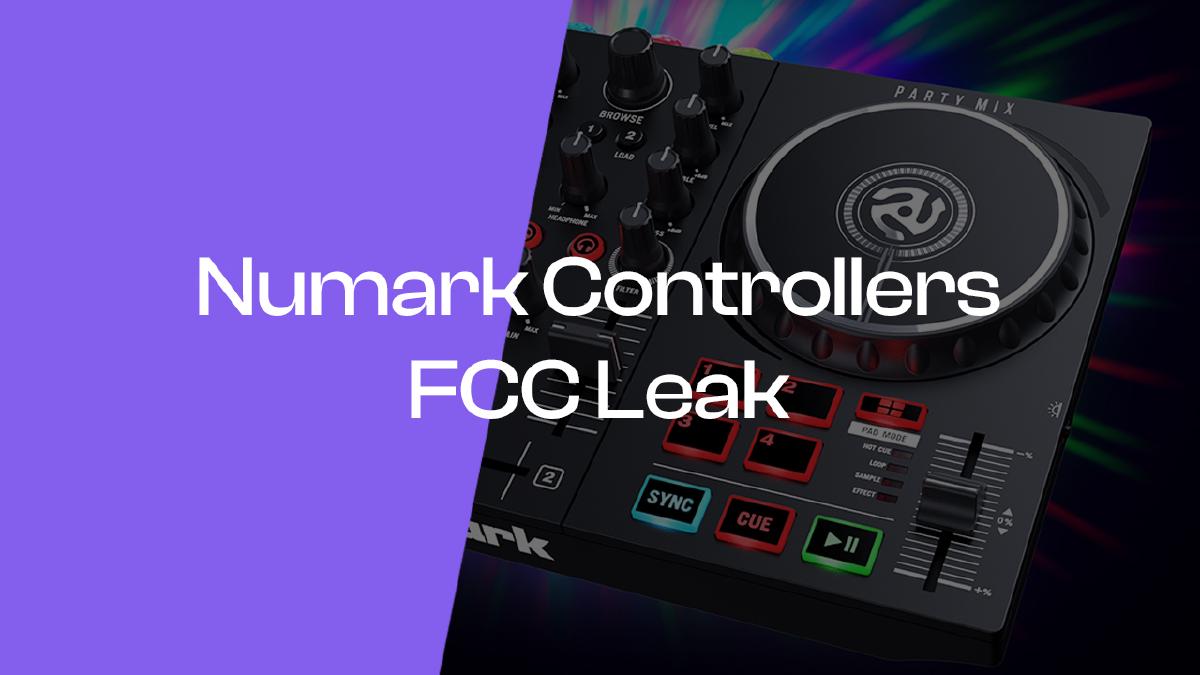
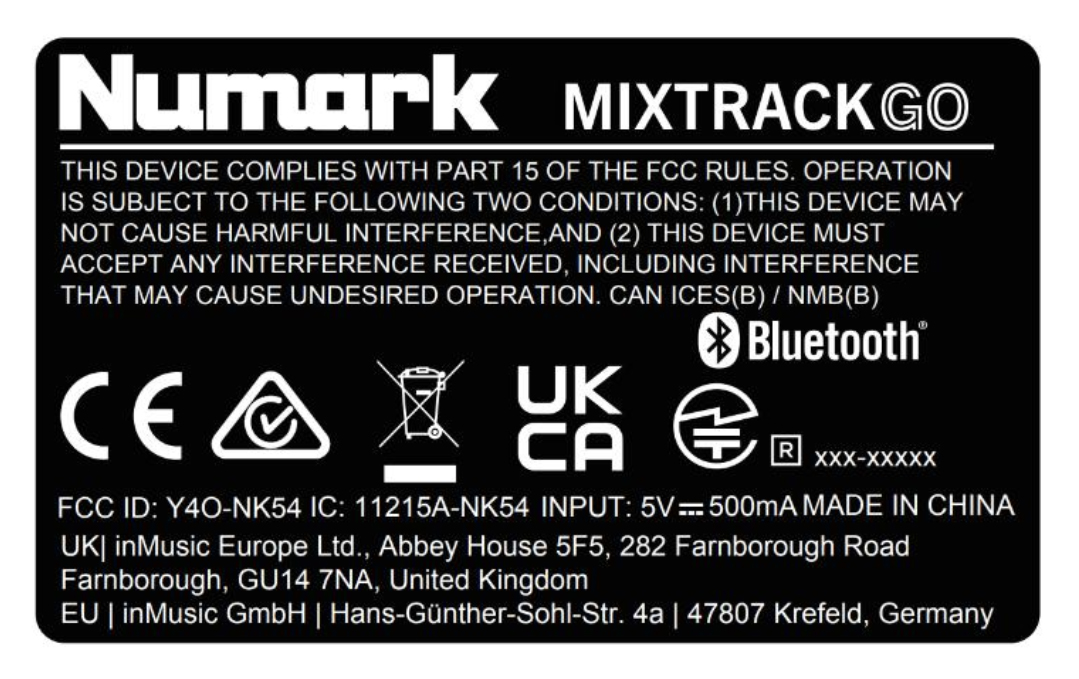
Two unannounced Numark controllers have surfaced in the FCC’s equipment authorisation database: an ultra-portable unit filed as the Mixtrack GO (Y4O-NK54), and inMusic’s next entry-level light-show deck, the Party Mix III (Y4O-NK55).
Neither has been officially announced. But the two filings share a lab, a schedule, a radio and an antenna report - and both name stem control as a feature. Read together, they look like one coordinated push to move stems down into Numark’s cheapest gear.
What follows is an objective read of the regulatory data. Where something is inferred rather than stated in the documents, it is flagged as such.
The Raw Data #
| Feature | Mixtrack GO (NK54) | Party Mix III (NK55) |
|---|---|---|
| FCC ID | Y4O-NK54 |
Y4O-NK55 |
| What it is | Ultra-portable 2-deck controller | 2-deck controller with built-in party lights |
| Stem control | Named as a feature (layout not shown) | Named as a feature (layout not shown) |
| Wireless | Bluetooth LE (2.4 GHz) | Bluetooth LE (2.4 GHz) |
| Power | 5 V USB (current draw inferred) | 5 V USB / 500 mA (label-confirmed) |
| Australian sale | Not established from filing | RCM mark present - cleared for AU |
| Release window | Grant date + 180 days (unconfirmed) | Grant date + 180 days (unconfirmed) |
Both units share the same radio and the same antenna characterisation report, so at the wireless level they are effectively the same subsystem in two different boxes. Beyond that, the filings describe two low-cost, portable, two-channel controllers that both carry stem control - and not much else can be stated as fact yet.
Stems Move Down a Tier #
The part worth sitting with is positioning. Both units are entry-tier consumer products, and both list stem control in the description the FCC sees. Until recently, real-time stem separation was treated as a premium feature. Seeing it named on the absolute baseline of the Numark range - the Party Mix line is the built-in-light-show starter deck - is the real signal here.
If these filings represent the final shipping hardware, stems stop being a pro-tier differentiator and become something a beginner expects out of the box. That is a meaningful shift, whatever these controllers eventually cost at retail.
What the filings do not show is how the stems are handled - pad layout, dedicated buttons, any mapping split. The internal photos and manuals that would answer this are held back under a 180-day confidentiality lock, so any specific description of the control surface is speculation until those publish.
Power and Wireless #
Both units are 5 V USB devices. The Party Mix III’s label confirms a 5 V / 500 mA rating; the Mixtrack GO’s label is withheld, so its current draw is inferred from the standard USB ceiling rather than stated. A 5 V bus device is built to run off a phone, tablet or laptop port rather than a mains brick - but both filings also went through mains conducted-emissions testing, so a wall-adapter path exists too. For the light-equipped Party Mix III in particular, a light show draws more than a 500 mA bus budget likes, so we can only speculate on whether it runs bus-powered in practice or leans on an adapter.
On the radio: both are Bluetooth LE on the 2.4 GHz band. That is confirmed. Whether that Bluetooth link carries wireless MIDI, control data, or something else is not stated in the filing, so we can only speculate on how the wireless side is actually used.
Form-factor note: The RF-exposure paperwork evaluates both units at 20 cm under the mobile-device standard - i.e. as arm’s-length surface controllers, the way you’d sit a controller on a desk. It does not indicate a body-contact or close-proximity device, so read nothing lap-or-couch into it either way.
One Programme, Two Boards #
The strongest finding here is that these two filings were run as a single coordinated programme, not two unrelated submissions. Both were received by the same test lab on the same day, both sets of reports were issued on the same day, and both application packages were signed off together. They share the same antenna characterisation report and the same Bluetooth radio.
They are not, however, the same board. The two carry different power tunes and different form factors - one ultra-portable, one with a built-in light show - and neither filing’s model-difference declaration names the other. The accurate read is a common inMusic wireless module reused across two different controllers, not one unit wearing two badges.
On timing: the coordinated certification supports these shipping as a linked pair, but it does not fix a retail date. The real release gate is the grant date, which starts the 180-day photo lock, and it is not yet posted on fccid.io/Y4O. Any specific launch month doing the rounds is speculation until that date appears. We can say these look designed to arrive together; we cannot yet say when.
The Software Question #
The open question is which software these are built to showcase. The Party Mix line has historically shipped hardware-unlocked for Serato DJ Lite, so a Serato-lineage stem workflow - Serato’s own Stems, or a paired mobile app - is the natural starting assumption. The filing names no software partner for either unit, so this is speculation, not fact.
Worth flagging that the reflexive “this must be a djay Pro showcase” call doesn’t automatically fit a Serato-lineage controller. djay Pro leads on mobile stem separation, but nothing in these documents points to it here - so we can only speculate on the pairing until Numark says otherwise or the manuals publish.
For anyone teaching, the practical read is simpler than the software politics: a pair of sub-club-price portables that can isolate a vocal or a drum stem gives students a real surface to practise stem-based mixing on before they touch a booth rig.
Caveat #
Regulatory documents confirm radio compliance, power characteristics and certification for hardware that exists in a lab. They do not guarantee final retail features, naming, pricing, or that either unit ships at all. Treat the specs above as verified-as-filed, the shared-programme read as strong inference, and any launch date as unconfirmed until the grant date posts on fccid.io/Y4O.