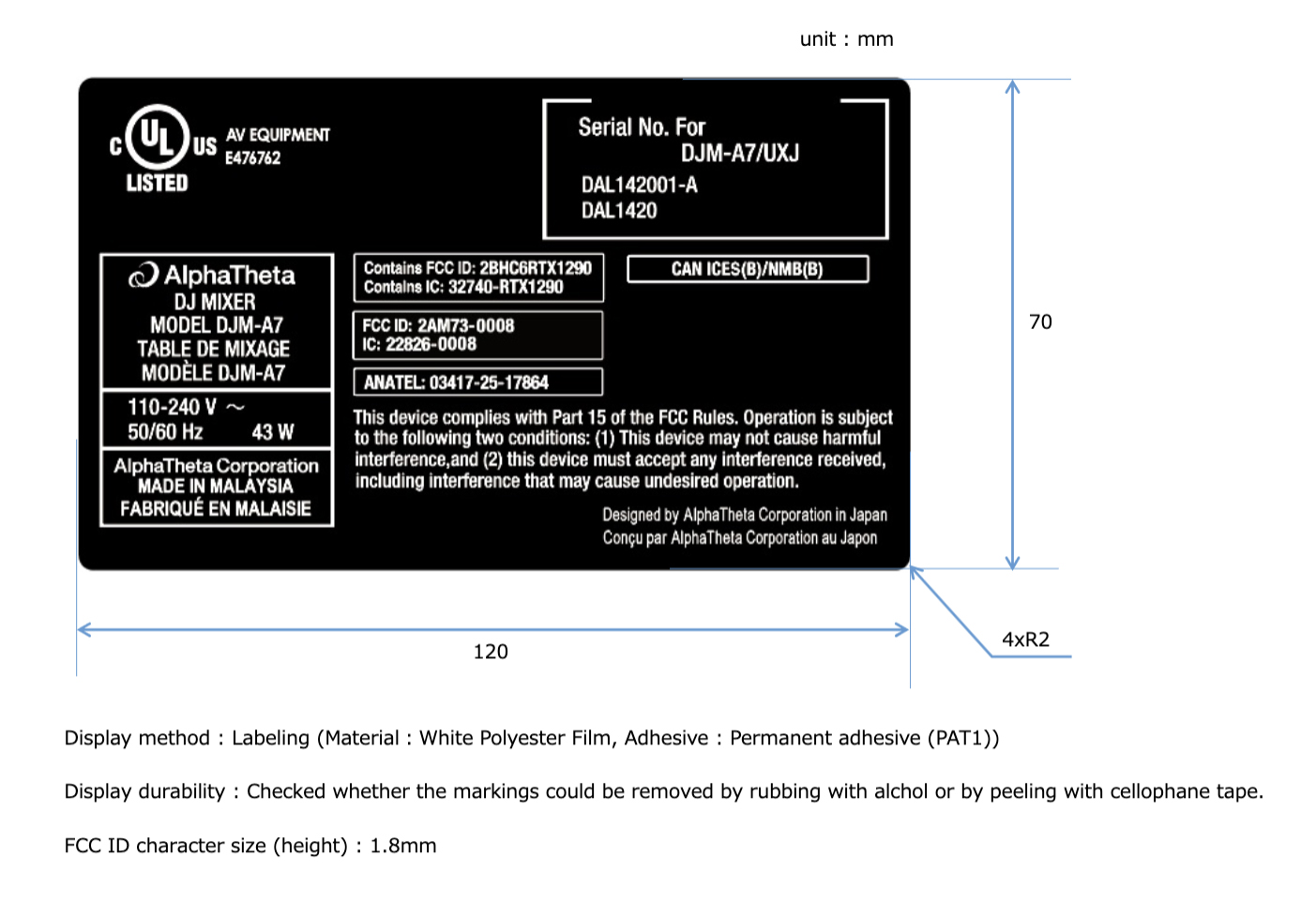
An unannounced AlphaTheta club mixer has surfaced in the FCC’s equipment authorisation database as the DJM-A7 (FCC ID 2AM73-0008), filed by AlphaTheta Corporation and built in Malaysia. The description on the paperwork is deliberately plain: the EUT line just reads “DJ Mixer.”
Nothing has been officially announced. The public test report and label drawings confirm two radios on board: a short-range 13.56 MHz NFC transceiver, and a bought-in 2.4 GHz wireless module. What the filing does not do is say what that 2.4 GHz radio is for - so the most interesting question about this mixer is exactly the one the documents leave open.
What follows is an objective read of the regulatory data. Where something is inferred rather than stated in the filing, it is flagged as such.
The Raw Data #
| Feature | DJM-A7 (2AM73-0008) |
|---|---|
| FCC ID | 2AM73-0008 |
| What it is | “DJ Mixer” (filing); full-size mains club mixer (inferred) |
| Maker | AlphaTheta Corporation - made in Malaysia |
| Short-range wireless | 13.56 MHz NFC (confirmed) |
| 2.4 GHz wireless | Bought-in certified module; confirmed present, purpose not stated |
| Power | Mains, 110 - 240 V, 43 W (not bus-powered) |
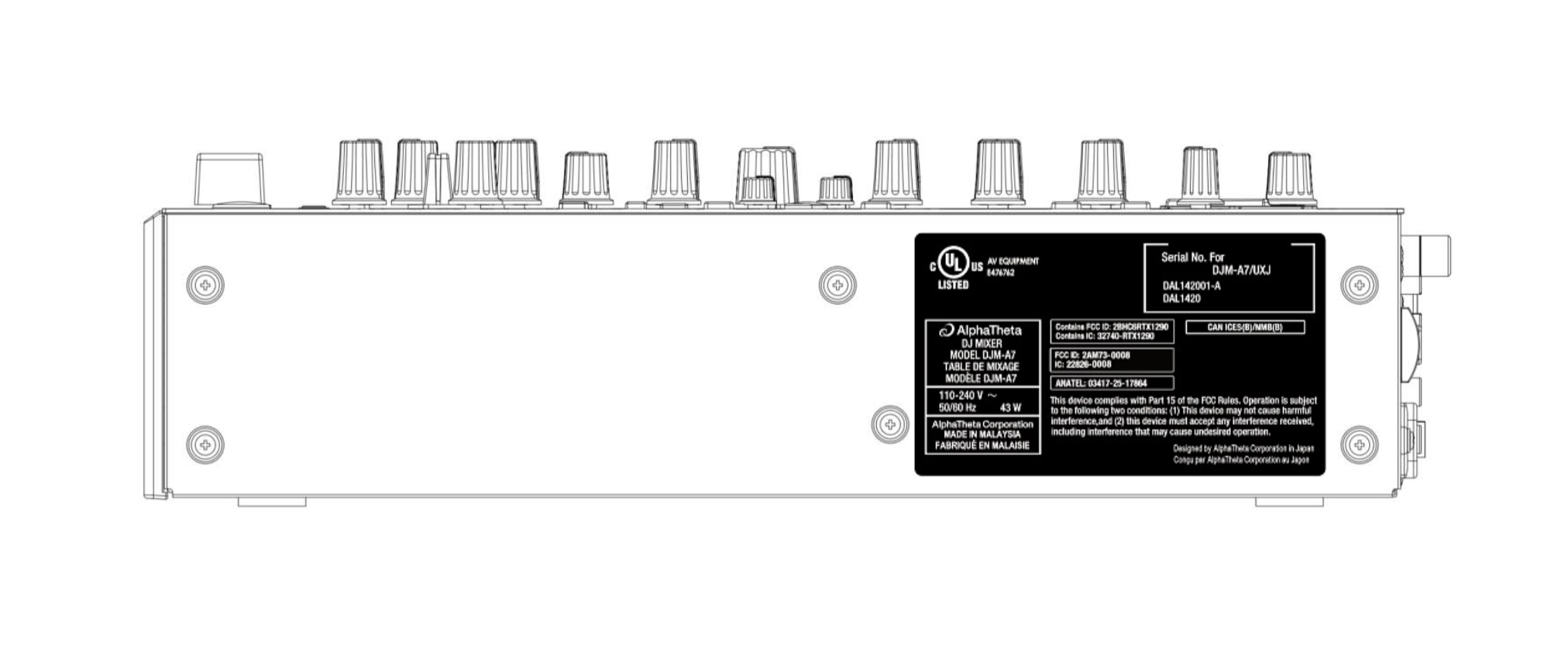
| I/O (read off the test rig) | 4x phono/line, XLR master, booth TRS, REC out, mic (XLR), LAN, three USB-C, headphone |
| Release window | Grant date + 180 days - grant date not yet confirmed |
The shape of the device is clear enough from the filing: a full-size, mains-powered club mixer with a standard professional I/O set. The wireless subsystem is the part the documents won’t fully explain.
Where It Sits in the Range #
The “A” line is AlphaTheta’s club-mixer range, topped by the 4-channel DJM-A9. An A7 slots in beneath it, and the I/O wired up on the test bench reads like a workhorse-tier club mixer rather than a flagship: four channels of phono and line, master XLR, booth TRS, a mic input, and LAN for Pro DJ Link.
Enthusiasts have pegged this as a spiritual successor to the DJM-750MK2, and the I/O is consistent with that read - but the filing never states a channel count, a tier, or dimensions as a spec. The “four channels” comes from four phono/line cable pairs on the test rig, not a published sheet, and the control-surface layout is behind the confidentiality lock. Treat the 750-successor framing as a reasonable lineage guess, not a filing fact.
Two Radios, One Unanswered Question #
The filing carries two separate radios, and it is worth being precise about what each one is - and isn’t.
The 13.56 MHz NFC coil is a near-field transceiver (ASK modulation, internal non-removable antenna), the touch-range kind of link you hold a card or tag against, not a data-comms radio. Its output is measured in billionths of a watt, which is exactly what you’d expect from a coil meant to talk to something a few centimetres away. On the test bench it was read against an NFC tag. What it is used for on the shipping product - pairing, settings transfer, something else - is not stated anywhere in the filing, so we can only speculate.
The 2.4 GHz module is the more interesting one, and the more misread. It is a bought-in part, certified separately under its own FCC ID (2BHC6RTX1290), and the mixer’s filing evaluates it for RF exposure as a “WLAN 2.4 GHz” radio. That “WLAN” label is the strongest clue the documents give - it points to a Wi-Fi-class radio. But the module’s actual details (its modulation, channel plan, whether it also carries Bluetooth) live in the module’s own separate grant, not in this filing, and crucially the DJM-A7 paperwork never states what the radio is for.
So here is the honest read, and it corrects a more confident version that has circulated: there is a 2.4 GHz wireless radio on board, and the filing will not tell us its function. One popular guess is SonicLink, AlphaTheta’s low-latency 2.4 GHz wireless headphone monitoring that debuted on the DJM-V5 in January 2026 - and it’s not an unreasonable guess, since the V5 pairs its SonicLink headphones by NFC touch, and an NFC coil sitting beside a 2.4 GHz radio does echo that arrangement. But the word SonicLink appears nowhere in these exhibits, no document describes any wireless-monitoring function, and the module is classified as WLAN, which if anything leans toward a Wi-Fi-class radio than a proprietary audio link. A cloud or networking feature is equally just a guess. We can only speculate on the function until the photos, manual, or an official announcement land.
Target Timeline #
This is where the earlier read most needs correcting. The short-term confidentiality lock - external, internal and test-setup photos, plus the user manual - runs for 180 days from the grant date, not the filing date. And the grant date is not present anywhere in this exhibit set.
The most recent document here is the RF-exposure report, issued 8 June 2026, so the grant can only be on or after that. That means the specific embargo-lift date - and any “December 2026” figure derived from it - is grant-plus-180 arithmetic off an assumed grant date, not a date the documents state. The window is real (roughly six months after grant, on standard AlphaTheta practice), but the actual month cannot be published until the grant date is confirmed on fccid.io/2AM73. Until then, treat any specific launch or embargo month as unconfirmed.
For the record, the deeper exhibits - block diagram, schematics, operational description - sit under indefinite long-term confidentiality, so the exact behaviour of the NFC and 2.4 GHz functions will not be confirmable from the filing itself even after the photos publish.
Why It Matters #
Strip away the guesswork and one filing-grounded point remains: AlphaTheta is putting a second radio into a club mixer at a tier below its flagship. Whatever that radio does, a manufacturer adding wireless to standard booth gear - rather than to a compact home unit like the V5 - is the more telling signal here, because the booth is where working habits get set.
If the 2.4 GHz radio turns out to be wireless monitoring in the SonicLink mould - and that remains a speculation, not a finding - there’s a real teaching angle in it. Cable-free monitoring changes the ergonomics students learn: no headphone lead snagged on a fader, but a new set-up step (pairing, battery, latency) to get right before a gig. The headphone-cable muscle memory we teach today would start to date. But that whole scenario hangs on a function the filing doesn’t confirm, so it stays a conditional worth watching, not a conclusion.
Caveat #
Regulatory documents confirm structural compliance, power characteristics and radio certifications for hardware that exists in a lab. They do not guarantee final retail features, naming, pricing, or that the unit ships at all. The 13.56 MHz NFC and 2.4 GHz WLAN radios are confirmed present as filed; their functions are not stated in the documents, so the SonicLink and cloud readings are both speculation. The release window runs from a grant date the filing does not pin - verify it on fccid.io/2AM73 before treating any month as fixed.