The inMusic FCC filings we covered a few weeks back are now real. Numark made the Mixtrack GO and the Party Mix III release official this week - and they did it with a coordinated rollout.
The product pages went live on numark.com, and within the same window nearly every DJ channel worth watching - Noisegate, Andertons, Store DJ, Digital DJ Tips, DJ City, Nick Spinelli and Numark’s own walkthrough - dropped hands-on videos at once. A planned launch like this tells you inMusic wanted these two framed as a pair from the first minute.
Stems come to the bottom of the range #
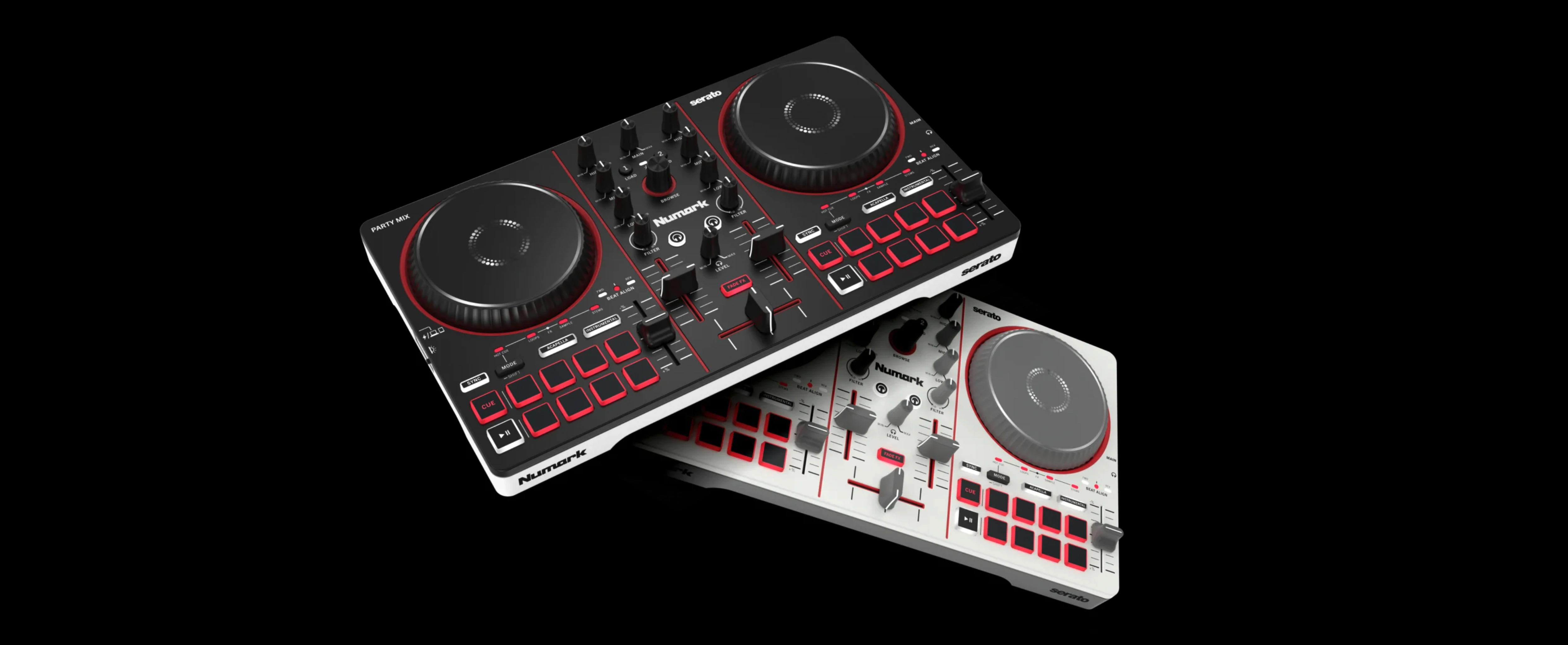
The headline here is stems. Both units ship with dedicated stem separation - a Stems pad mode plus standalone Acapella and Instrumental buttons that stay live whatever else the pads are doing. That matters because real-time stem control has, until very recently, been a feature you paid serious money for. Seeing it land on a $99 controller is the clearest sign yet that inMusic is willing to push its headline features all the way down to the entry tier rather than reserving them to protect the pro range.
For anyone teaching, that is more interesting than it sounds. Stems are not just a performance toy; pulling a track apart into vocals, drums, bass and melody is one of the fastest ways for a new DJ to actually hear how a record is built. Having that on the cheapest controller in the catalogue means a student can start learning arrangement and phrasing on day one, on gear they can afford, rather than waiting until they are three rigs up the ladder.
One caveat worth passing to buyers before they get frustrated: stems need source material the software can analyse. Local files work, and so do Tidal, SoundCloud and Beatport streaming, but Spotify and Apple Music will not drive the stem features. If a beginner wonders why the Acapella button does nothing, that is almost always why.

Lessons built in, via Crossfader #
Both controllers come with a free video course produced with Crossfader, unlocked by a QR code in the box. It runs from unboxing to a first proper mix and includes music to practise with, so a complete beginner is not stuck sourcing tracks before they can start. A sensible addition - the hardware is explicitly aimed at people who have never touched decks, and shipping structured lessons with it closes the most common gap between buying a controller and actually using it. A huge milestone for Crossfader after 10 years providing quality coverage and support to the DJ community.
What is actually confirmed #
Now that the units are in hand and the spec sheets are public, here is where the two land.
| Mixtrack GO | Party Mix III | |
|---|---|---|
| Form factor | Ultra-compact 2-deck | Compact 2-deck with light show |
| Dimensions | 324 x 93 x 40 mm | 339 x 205 x 47 mm |
| Weight | 0.6 kg | 1.1 kg |
| Performance pads | 4 per deck | 8 per deck |
| Mixer | Filter knob per channel, switchable to Low EQ | 3-band EQ plus filter per channel |
| Beat Align | No | Yes |
| Lights | No | Beat-synced LED show |
| Jog wheels | Capacitive touch | Capacitive touch (larger) |
| Soundcard | 24-bit / 48 kHz, main + headphone out | 24-bit / 48 kHz, main + headphone out |
| Wireless | Bluetooth LE MIDI (BT 4.2+) | Bluetooth LE MIDI (BT 4.2+) |
| Power | USB-C bus power, 5 V 500 mA, no battery | USB-C bus power, 5 V 500 mA, no battery |
| Free software | Serato DJ Lite + Algoriddim djay / djay Pro | Serato DJ Lite + Algoriddim djay / djay Pro |
| Price (US) | $99 | $149 |
| Replaces | DJ2Go / DJ2Go Touch | Party Mix 2 |
The two share a lot: the same 24-bit soundcard with main and headphone outputs, capacitive jog wheels, Fade FX on the crossfader, the full run of pad modes, USB-C, and Bluetooth LE for wireless MIDI. They are bus-powered with no internal battery, so running one off a phone means carrying a power bank to keep the phone from draining. Both come with a USB-C cable, a 3.5 mm to RCA adapter and a phone stand, and both are out now in black, with a cream finish following at select retailers.
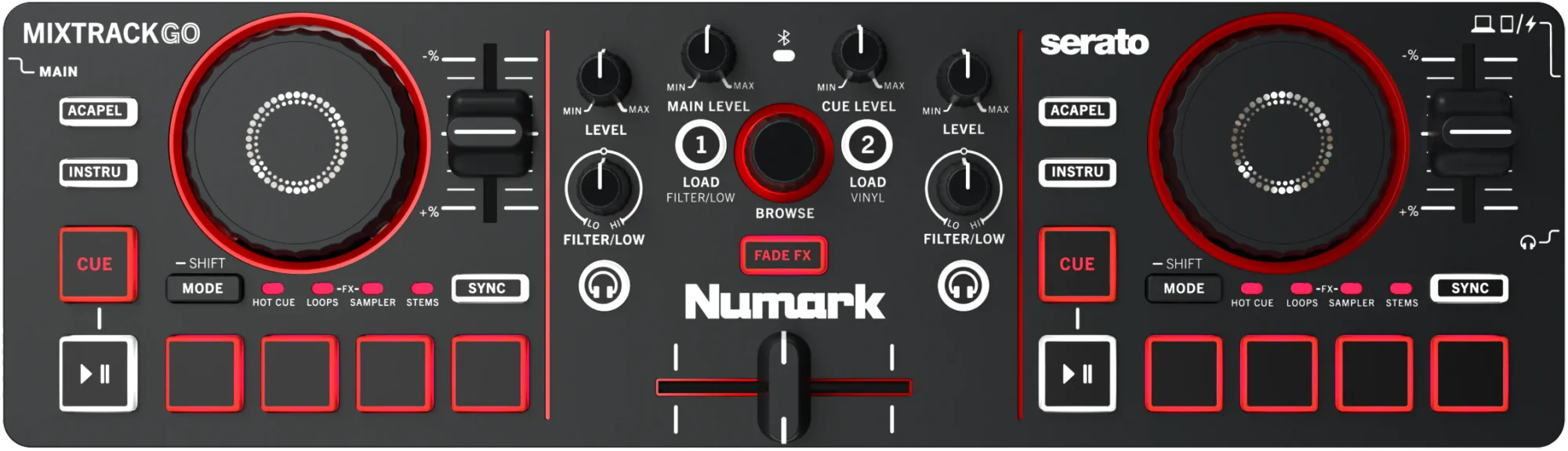
Where they split is size and ambition. The Mixtrack GO is the travel unit - tiny, four pads a deck, no full EQ (the filter doubles as a low-EQ kill), and level controls that are actually rotary faders rather than trims. It is built to live in a bag and run off a phone. The Party Mix III is the home-learning unit: eight pads a deck, a proper 3-band EQ, bigger jogs, the beat-synced light show the line is named for, and Beat Align, a visual aid that shows you which deck is ahead so you can learn to beat-match by ear instead of leaning on sync. Its layout sits much closer to the club gear a student will meet next, which is the stronger argument for the extra fifty dollars.
A couple of honest limitations on both: there is no microphone input, no way to toggle master-cue monitoring from the hardware itself (you set headphone-only practice in the software), and the output level is on the quiet side - fine into a consumer Bluetooth speaker, but you may struggle to drive a mixer’s aux at a party. And despite some launch coverage describing “Bluetooth audio,” the wireless link is MIDI only. In wireless mode your phone or laptop handles the sound, so there is no wireless headphone monitoring from the unit.
On software, both unlock Serato DJ Lite and Algoriddim djay - including djay Pro on desktop - for free, with Serato DJ Pro and VirtualDJ available if you already hold a licence. Worth knowing which to point a beginner at: Algoriddim’s free tier, unlocked by the hardware, gives you the stems, pre-cueing, the sampler and crossfader FX, while Serato DJ Lite is desktop-only and more limited. For a phone-first learner, Algoriddim is the stronger free pairing.
Where our first article got it wrong #
Back when these were still just FCC filings, we decoded them and got a fair amount right - the coordinated two-device programme, stems on entry-level gear, BLE wireless MIDI, and the bus-powered design all held up. But two calls missed, and it is worth being straight about why.
The bigger one was timing. We read the confidentiality lock on the filing as a release window and put these in October - the Party Mix III piece even said the date was “locked.” It was not. The units shipped on 7 July, roughly three months early. The mistake was treating the lock as a launch date when all it actually governs is when the withheld FCC exhibits - the internal photos and manual - can be published. A manufacturer is free to ship the product well inside that window and simply keep the paperwork dark, which is exactly what inMusic did. Lesson banked: a lock date is a ceiling on secrecy, never a shipping date.
The second was software. We flagged djay Pro as the likely showcase, which was us reaching for a familiar theme - the Algoriddim mobile-stems story we come back to often - instead of reading the Party Mix line’s own history, which has shipped with Serato for years.
The reality is a dual bundle, Serato and Algoriddim together, so the software was not the failure. The framing was, and it was wrong because a house angle got ahead of the lineage in front of us. Both are the kind of miss worth logging out loud, because the whole point of decoding filings early is being clear about which parts are solid and which are us filling in the gaps.