A solo developer has released ‘DJ Life Simulator: Learn to DJ for Real’ into Early Access on Steam. The pitch is unusually direct for the genre: not a rhythm game, not an arcade fantasy, but a tool that claims the skills you build in-game carry over to real decks.
The Brazilian One Day Code Games (posting on reddit as u/Constant_Active_5551) states a background of seven years DJing and four years teaching. That teaching angle matters, because the whole product is built around it: two modes, a lesson-based DJ Academy and a progression-based Career mode, both aimed at taking someone from zero to competent on a controller.
Editorial - First Look:
This is an initial impression, written from published material and community threads. I have not tested the game hands-on, and I have no relationship with the developer at time of writing. I will be in touch with One Day Code Games to confirm details and ask a few questions. Corrections and responses will land in an update or a Part 2.
Under the Hood #
The build is off-the-shelf game tech pointed at a niche problem:
- Engine: Unity, written in C#. The developer states roughly 20% of the code was AI-assisted, with art commissioned from artists and music supplied by partner producers.
- Input: Mouse and keyboard, or a real USB / MIDI DJ controller. AlphaTheta (Pioneer DJ) gear is described as plug-and-play; Serato, Hercules, Numark and supported Traktor controllers need a one-time MIDI mapping.
- Library: Import your own MP3 or WAV files, or bring in a rekordbox XML library. The game generates waveforms and detects BPM and key on import.
- Platforms: Windows and macOS. Steam Deck compatibility is currently listed as Unknown.
What It Actually Does #
Stripping the store copy back, the feature set is broader than most learn-to-DJ apps:
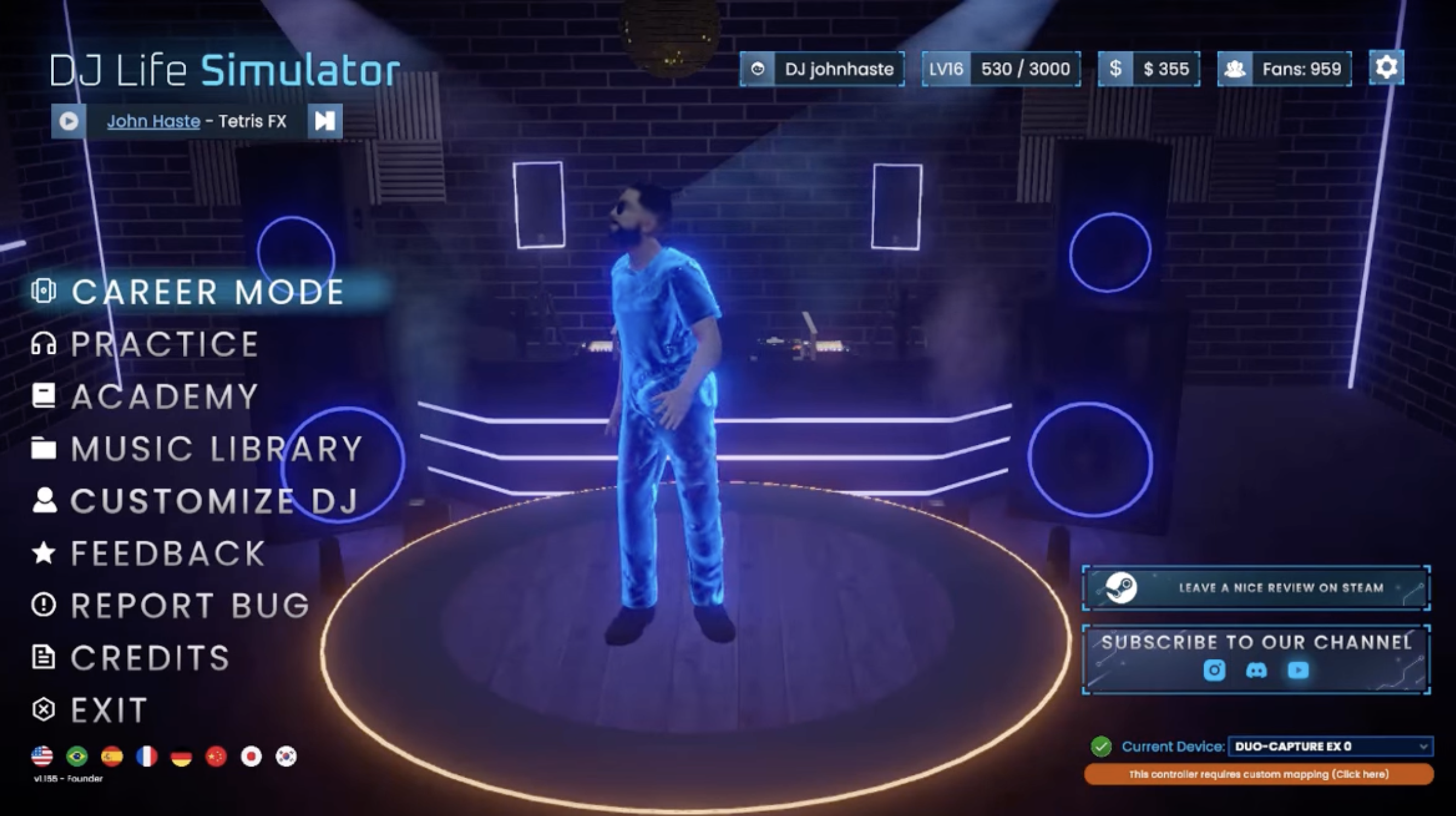
- DJ Academy - gamified lessons covering beatmatching, EQ, transitions, harmonic mixing (Camelot wheel), loops, effects, track selection and how to end a set.
- Career mode - missions from house parties up to festival stages, with money, fans, unlocks and reputation tied to how well you actually mix.
- Minigames - situational challenges built from real booth annoyances: awkward requests, drunk or smoking punters crowding the decks, split-attention tasks.
- Reactive crowd - dancers with musical preferences signalled by their clothing, reacting to your track choices. Worth noting up front: the crowd system currently responds to electronic genres only (house, techno, trance), so this is narrower than “read any dancefloor”.
- Customisation - character and clothing bought with in-game earnings.
The developer frames the project modestly, and to his credit, not as a replacement for lessons - he describes it as a way for “curious people to start playing” without the cost of gear or a private course. That framing is fair and an interesting take on skill acquisition.
The Pitch, and the Gaps #
The store page reaches for superlatives - it calls itself the first sim that teaches you to DJ for real, and “the only game where fun truly turns you into a professional DJ.” Those are marketing lines, not verified facts, and the community itself has already reached for a more grounded comparison: on r/rocksmith it’s framed as a Rocksmith for DJing - an alternative route to actually learning, rather than a magic one. That is the honest register for this thing.
The bigger question is the “100% transferable” claim, and it runs into the Early Access feature list. As it stands there is no headphone cue / pre-listening, no scratching, no Performance Pads and no Beat FX - all noted as planned. Cueing by ear is half of what beatmatching is on real gear, so a tool that cannot pre-listen cannot yet teach that. This is the central tension of the project, and it is the first thing I want to put to the developer directly.
A few more to flag rather than settle here:
- Controller compatibility wording. The game was cross-posted to r/Serato under a “compatible with any Serato gear” banner, which drew pushback in that thread. The accurate version, from the developer’s own replies, is narrower: it works with Serato-based hardware (a DDJ-SB, for example) via MIDI mapping, not with Serato’s software. Native Serato integration is described as in progress.
- Detection accuracy. The developer has said BPM detection is right about 70% of the time and off by a beat or two the rest, a real caveat for a tool built to teach beatmatching.
- Scope of “reads the dancefloor.” As above, electronic genres only for now.
None of this makes the project dishonest - most of these limits are stated somewhere by the developer, often in the comments rather than on the store page. The follow up of this story will be where these limits are collected into one place.
Pricing #
Stated plainly, per Editorial policy:
- Free demo on Steam.
- Early Access: listed at €20.49 (a launch discount was live during the release window - check the current price before you buy). The developer states the price will rise as content is added.
- The paid version unlocks own-music import and a bundled free online DJ course via the project site.
- Content gating (the developer’s own figures): Career mode ships with 9 missions across 3 stages, expanding to 18 and 6; the Academy ships with 13 lessons, expanding to 20. Beat FX and audio output through the controller are held back for the full release.
How It’s Landing #
Reception across the DJ subreddits has been broadly warm, with the usual solo-dev goodwill and a steady stream of feature requests - scratching, pad FX, cue-point import, more languages. The developer is responsive and open about the tool’s limits in the threads, which is the right posture for an Early Access build. There is a real audience here: beginners priced out of gear, and DJ schools reportedly using it as a teaching aid with a teacher-facing progress panel. Those partnership numbers are the developer’s own, and worth confirming.
What Happens Next #
This article is Part 1. I will be contacting One Day Code Games with a few questions regarding the tech stack, the methodology behind BPM and key, pricing, the export story, controller-integration roadmap, the school data panel, and the honest comparison against just buying a cheap controller or running Mixxx for free. Their responses, and any pushback on the article above, will shape the update.
Until then, treat this as a documented first look.
Have you tried DJ Life Simulator? I want to hear from beginners and DJ educators before Part 2 - tell me what it got right and where it fell short at: contact@beatform.com