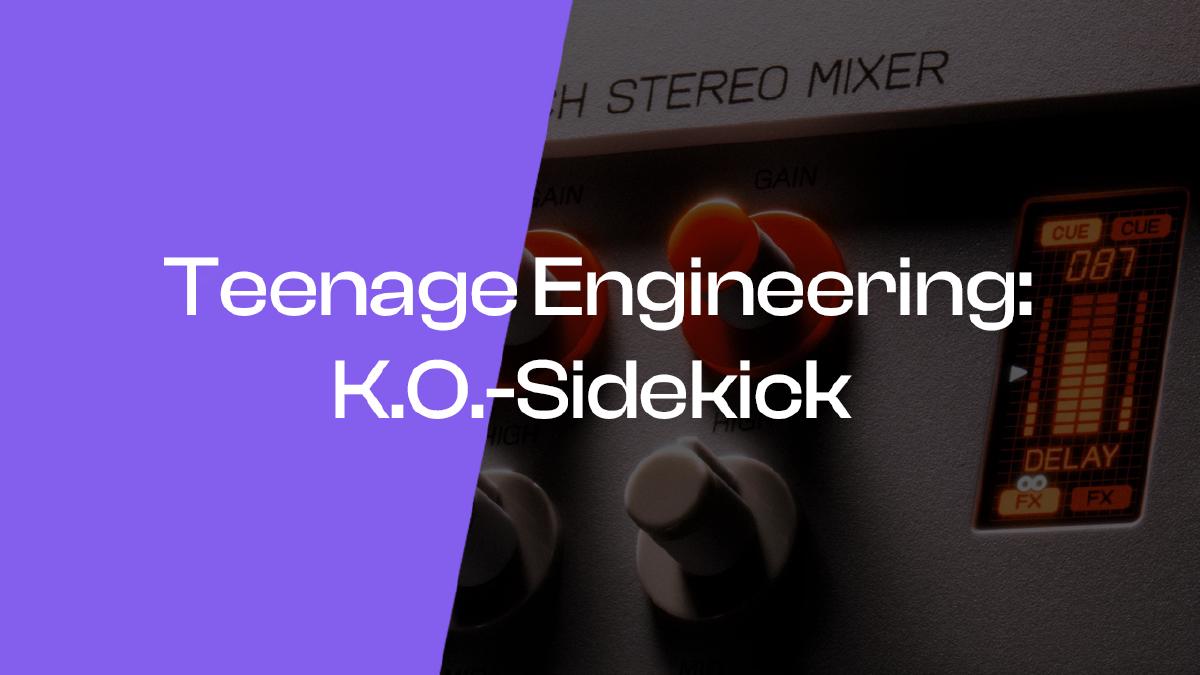
A DJ posted their travel setup on r/DJSetups. Forty-four comments later, the thread had worked out more about the Teenage Engineering EP-136 K.O.-Sidekick than most spec sheets manage.
My first glimpse at Teenage Engineering’s EP-136 K.O.-Sidekick did not come through the usual DJ press channels. Instead it surfaced in a post on r/DJSetups, from a DJ using it as a hotel-ready and impromptu-party unit, running it as a MIDI controller into rekordbox. As is usually the case in a post like this, the comments section quickly stacked up what the device actually is compared to how many DJs assumed it would behave. After a Youtube search, this DJcityTV review gave run on a full rundown on the unit, closing any gaps that remained.
What it actually is #
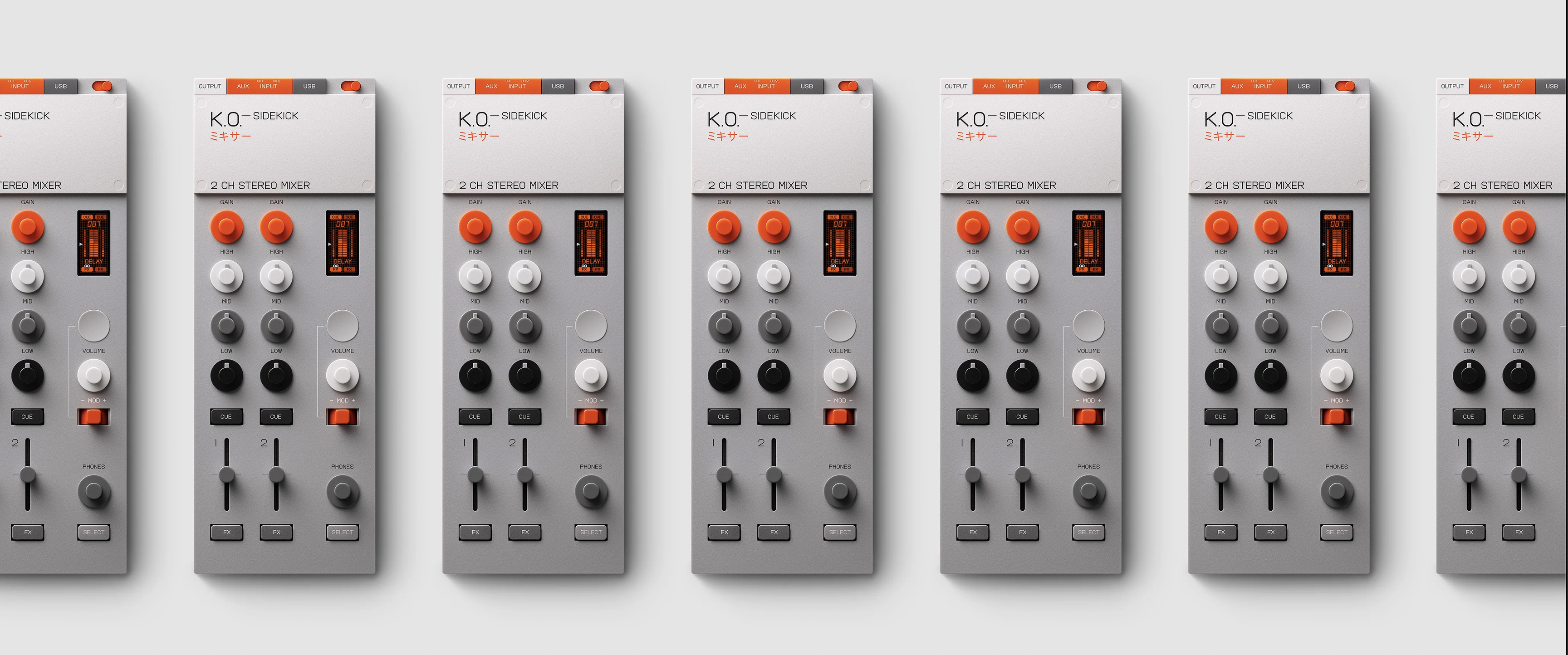
Strip away the form factor and the K.O.-Sidekick is a two-channel stereo mixer built around a USB audio interface. Teenage Engineering’s own specification lists two main channel strips, a third stereo aux input for a “session” source, three EQ modes (DJ, studio, and parametric), a three-type per-channel compressor, six effects with dual-channel routing, and an 8-in/4-out USB audio interface running at 48kHz/24-bit. It can be powered by USB-C or by two AAA batteries, and it carries MIDI over USB in both directions, including a dedicated controller mode.
The price is the detail that anchors most of the discussion that follows: $179 USD, confirmed in the DJcityTV review. At that price point there is very little direct comparison. The reviewer notes the nearest big-name alternatives - the Reloop PTB2 and the Native Instruments Traktor Z1 Mark II - both sit above this price-point, with the Z1 not being a standalone mixer in the same sense. One Reddit commenter framed the same gap more bluntly, challenging anyone to name a digital mixer with a built-in sound card and effects for under 200 euro. Nobody in the thread did.
What the thread worked out #
The original poster’s use case was narrow by design: a MIDI controller mapped into rekordbox for casual, non-club sessions. The first substantive reply pushed back on that framing entirely, pointing out the Sidekick can be used as an actual mixer with direct audio routing rather than purely as a MIDI surface - feeding stereo pairs (channels 1-2 and 3-4) into DJ software as line inputs, sidestepping the controller layer altogether.
That distinction - mixer mode versus controller mode - was the thread’s real point of confusion, and Teenage Engineering’s own marketing doesn’t spell it out: the Sidekick can run as a MIDI controller, a standalone mixer, or both at once, decided entirely by routing choices in the settings menu, not the hardware itself.
A few smaller points of real-world friction came out cleanly:
- No drivers, genuinely plug-and-play. The original poster confirmed this directly in response to a question about USB class compliance.
- No independent cue-mix blend. The two volume knobs control master and headphone output level independently, not a blend between them - there’s no equivalent to the cue-mix pot found on something like a Traktor Z1 Mark II. One commenter noted this might be solvable through MIDI mapping in software that exposes it as an assignable control, but out of the box, it isn’t there.
- Headphone output is noticeably quieter than the master. The original poster added an outboard headphone amp to compensate, and separately noted the master output itself runs quiet enough that it benefits from an external amp in some setups.
The thread’s most substantial contribution was a full rekordbox MIDI mapping, posted in answer to how mixing works without a crossfader, jog wheel, or pitch fader. It repurposes controls the stock configuration doesn’t suggest: both gain pots double as library browse encoders with press-to-load; the cue buttons become play buttons; and “select” acts as a shift layer, turning the high and mid encoders into trim and FX depth when held. The per-channel FX button toggles the CFX filter, and select plus FX together triggers an outro chain - echo into vinyl slowdown into backspin. It’s dense, purpose-built, and the clearest evidence in the thread that the Sidekick’s appeal isn’t the mixer section as shipped - it’s the depth available once someone maps around its constraints.
What the review added #
DJcityTV’s review on a unit supplied by Teenage Engineering, filled in several things the Reddit thread only speculated about.
DVS doesn’t work, at least not cleanly. One question that came up unanswered in the Reddit comments - whether the Sidekick could handle timecode vinyl - got a direct answer from the reviewer: after testing routing options in the settings menu, no way was found to mute the incoming control signal, ruling out a clean DVS setup.
It genuinely works as a class-compliant interface in third-party software. The reviewer confirmed it functioning as an external USB mixer in Algoriddim’s djay Pro, describing it as usable in any DJ software not locked to specific hardware - consistent with the plug-and-play behaviour reported on Reddit, but tested against a second application.
Channels are physically expandable. The rear aux input doubles as a daisy-chain connection between multiple Sidekick units via a set of connector pegs Teenage Engineering sells separately - pegs the reviewer noted are dimensionally identical to a well-known children’s building-brick connector, which is how the review unit ended up testing the feature with a set borrowed from the reviewer’s kid.
Build quality reads better than the plastic shell suggests. The reviewer compared the construction favourably to Native Instruments controllers: dense, solid, well considered in where grip and spacing are used despite an outward toy-like appearance.
The display does more work than most mixers in this category attempt. Adjusting a gain or fader value shows the exact numeric value on-screen; the EQ display shows cutoff points in real time; effects can be locked into a fixed state via the select button; and a motion-control mode records effect parameter movements over time and plays them back as a sequence - a feature the reviewer nearly missed entirely, discovering it accidentally while trying to unlock a different control.
Battery backup is a real fallback, not a spec-sheet line. The reviewer ran USB power throughout the review but confirmed the AAA compartment keeps the unit alive if USB power is pulled mid-session, framing it as a genuine backup rather than a marketing checkbox.
No balanced outputs, which the reviewer notes as a real limitation but a fairly normal one at this price bracket - the mini-jack-only I/O (main, aux, headphone) is the trade-off for the compact form factor, and RCA connectivity would have forced a larger chassis.
Where the two sources agree #
Independently, and via different use cases, the Reddit thread and the review arrive at close to the same verdict. The original poster’s framing - “it is so functional for what it is” - and the reviewer’s closing assessment, calling it the ideal portable mixer for its combination of flexibility, power, and price, describe the same kind of device from different directions: one from someone mapping it into a specific software workflow over weeks of casual use, the other from a structured single-session review against the wider portable mixer market. Both flag the same real constraints - no dedicated cue-mix blend, no clean DVS path, quieter output than a full-size booth mixer - without treating them as dealbreakers for a device neither expected to be club-ready.
An idea raised in the writing of this article - DJCityTV describes the EP-136 as usable with “any DJ software which isn’t locked down to specific hardware’, and has me wondering about slimmer modular DJ setups. Combining this wil travel friendly players designed for and run through software like Djay Pro or Mixxx
Disclosure: Beatform has no commercial relationship with Teenage Engineering. Pricing referenced above ($179 USD) is as stated in the DJcityTV review; Beatform has not independently verified current retail pricing at time of publication.
Community claims from r/DJSetups are attributed to the individual commenters who made them and have not been independently re-tested on a Beatform-owned unit.