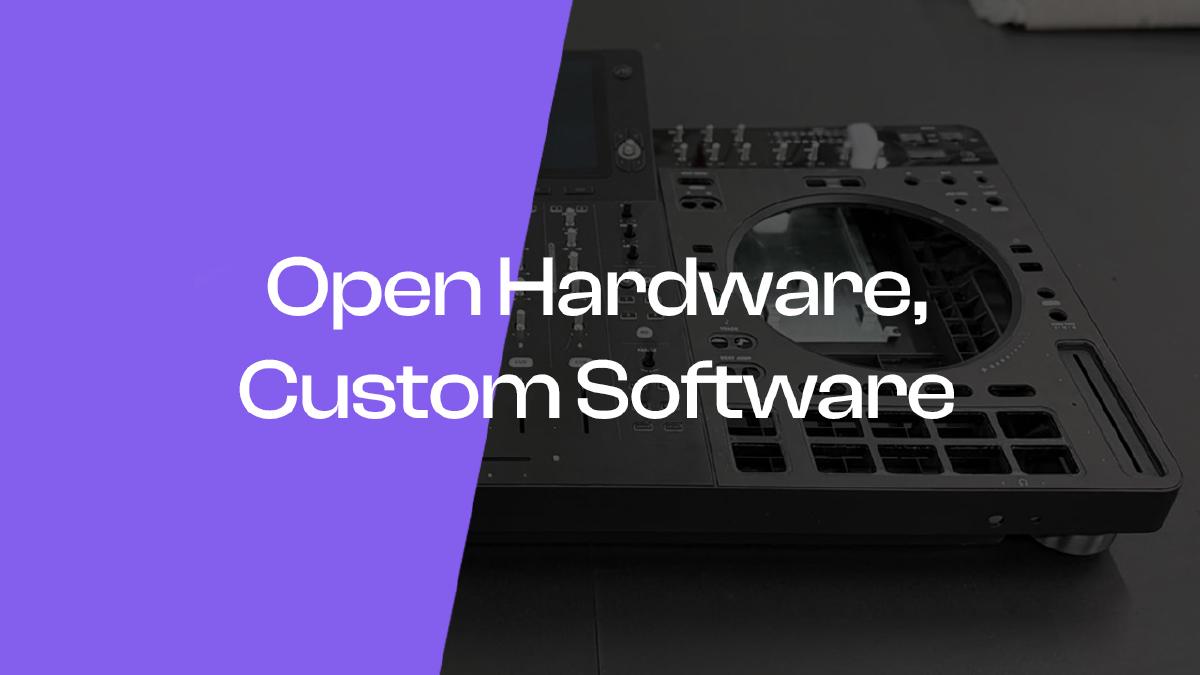
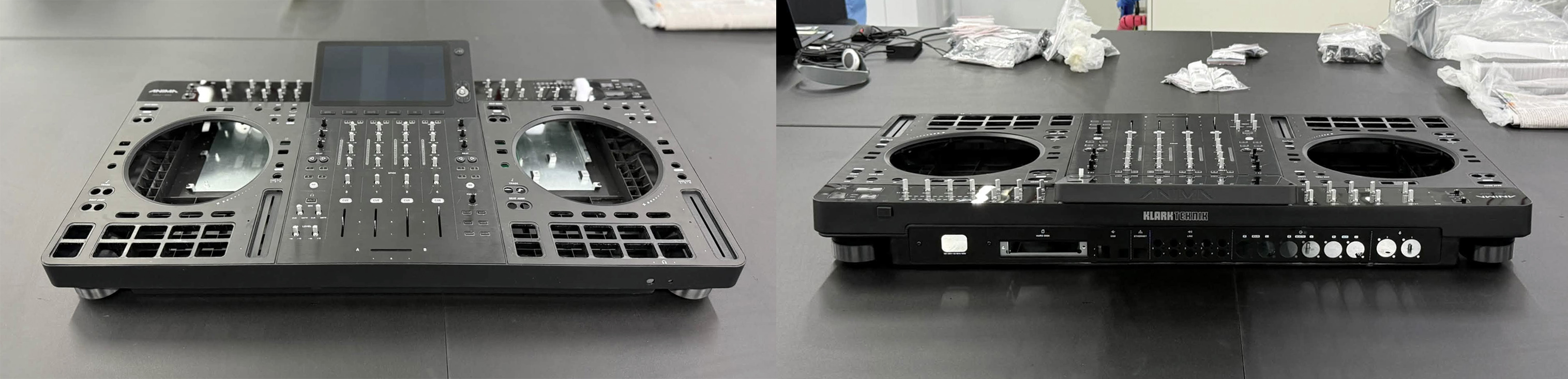
Behringer posted two photos of an unfinished DJ unit to Facebook under the headline “THE DJ INDUSTRY IS ABOUT TO CHANGE FOREVER.” The four-channel, all-in-one standalone is pitched as professional hardware at US$300 to 400, with open hardware and no proprietary lock-in so users can write their own software. Behringer says these are first prototypes, still being assembled in its own factory.
It was quickly picked up and shared on Reddit. The r/DJs thread passed 1,000 upvotes and 400 comments within a day, and a second thread on r/PioneerDJ followed. DJ TechTools covered the post the next day, and a week later the Mixxx project responded with a call for contributors, covered below.
Comments under the Facebook post show what some DJs want from it:
- Jog wheels. The most repeated request was mechanical jog wheels, with one commenter saying they could make or break the unit. Motorised platters, separate media players and a mixer layout modelled on a familiar club standard also came up often. DJ TechTools bets against motors at this price and suggests a removable jog module instead.
- Compatibility. Several asked whether it will run Serato or other DJ software they already use. One argued that unless it reads rekordbox libraries without conversion, it can’t change the fact that a DJ arriving at a club needs a USB that just works.
- Open means documented. Commenters asked whether Behringer will publish service manuals, spare parts, CAD files and schematics. One user asked whether there’s a mailing list, because they want to start writing software.
- Practical features. Rugged, weatherproof construction for mobile DJs, XLR outs, StageConnect, DMX and network ports, and the purpose of the rear option slot.
- Optimism. One saw it as a fast response to the AI-assisted mods appearing on Pioneer kit, and wondered whether Pioneer and Denon will go open source too.
- Scepticism. Some dismissed Behringer as the budget end of the market, asked whether it will rely on your own computer, or asked what you do when you turn up at a club. One comment questioning when Behringer moved from clones to shaping the industry’s future.
This piece is based on public material: Behringer’s Facebook post, Reddit discussion, video interviews and published reporting. I haven’t handled the hardware, and nothing about its price, specification or release date is confirmed.
What has actually been shown #
The photos show a rough prototype. DJ TechTools describes bare units at a factory, with jog wheels and pads not yet installed, but a clear layout of four channels, eight pads per deck, long pitch faders and a central touchscreen that folds flat. The top plate reads ANIMA, and the rear has a bay labelled HARD DISK alongside USB, Ethernet, line jacks, XLR outs and two mic inputs.
The rear panel also carries Klark Teknik branding - a British pro-audio brand that Music Tribe, Behringer’s parent, has owned since 2009.
On price, the post now says US$300 to 400, however it didn’t start there. The r/DJs thread transcribed it as US$400 to 500, and DJ TechTools says Facebook’s edit history shows Behringer cut $100 within the hour. If the price holds the units would be under a sixth of the Denon Prime 4 G2 (US$2,599) and under an eighth of the AlphaTheta XDJ-AZ (US$3,449). However, DJ TechTools questions how a touchscreen and a drive bay fit under US$400 while memory prices are rising.
Not announced, as far as I can find:
- a release date
- a processor or specification
- a licence for the hardware designs
- whether the unit ships with working default software
No firmware announcement has been made at this stage.
Why this landed #
I regularly read posts where newbies ask how to install rekordbox and whether it’s free. The copy included with Rekordbox onboarding gives the impression that the software is a time-limited trial (the base version in fact has no such time limit). I see that as slightly deceptive and a nudge toward paid tiers. Pioneer hasn’t claimed this as the intent, but I’ve seen it confuse people repeatedly.
Rekordbox matters because the club standard is Pioneer DJ, now AlphaTheta - people learn on it, and the hardware that reads a rekordbox exported USB is mostly theirs. In my experience in Australian dollars, a pair of older CDJs with a second hand club mixer sits around AUD 4,000. A current-generation CDJ and brand new mixer setup runs between AUD 10,000-15,000. Meanwhile entry-level controllers cost a fraction of that, sometimes with comparable functionality. For hardware that is mostly a computer with some knobs and a spinning wheel, I find the order of magnitude difference difficult to explain, especially when firmware updates are infrequent and bugs linger.
It seems that I’m not alone, with many others in the community sharing a similiar sentiment. One r/DJs commenter described years of unexpected rekordbox problems before gigs. Another, in the r/PioneerDJ thread, said their Opus Quad still crashes after about an hour despite a firmware update and reformatted USBs. These reports are anecdotal, but as a whole, a picture starts to emerge about the company and it’s attitude towards vendor lock-in.
The firmware scene arrived first #
Behringer’s announcement lands on top of something already underway. Over the last few weeks, DJ modders have been posting firmware for modern Pioneer units, and for older gear, using AI-assisted coding and reverse engineering to add features the original software never had. It’s limited by the hardware, because you can’t make a very old unit behave like a new one, but it’s reviving gear that was otherwise stuck. Several of these threads can be found in Tracked #10, and I plan to talk to speak with some of the modders directly.
One r/DJs commenter argued that Behringer’s approach is a direct response to that wave of custom firmware on devices like the SP404 and MPC. That is an interpretation, with nothing confirmed by Behringer themselves. However there is some precedent from the company, though. Music Tribe has published an open-source repository for the Behringer Kick, a standalone sampler and sequencer, and says it plans to open a selection of its designs so communities can use AI to build their own firmware.
DJ TechTools adds that the Kick source is under AGPL-3.0, that Music Tribe’s GitHub organisation page promises schematics and bootloaders and says the community will vote on what gets built next. It also says hardware ideas start in Music Tribe’s open source Discord, which is where to ask if you want something like a swappable crossfader.
Synthtopia reports no confirmed retail price or shipping date for the Kick, and frames the M-Vave FM-1 and its open hardware platform as the model Behringer appears to be following. Decoded Magazine’s coverage asks whether this is a genuine shift in who controls music technology.
The case for open hardware #
Andrew “Bunnie” Huang (the American researcher and author of the 2003 book ‘Hacking the Xbox: An Introduction to Reverse Engineering’), in a Feedback Loop interview, frames hacking as understanding a system until its boundaries stop applying, with the goal of showing ordinary people they can control their own devices. He’s part of a lawsuit challenging Section 1201 of the US DMCA, which criminalises bypassing digital locks, and argues it blocks people from modifying media and tools they legally own. He also contrasts restrictive IP regimes with Shenzhen’s hardware ecosystem, where shared processes and minimal NDAs produced a more adaptable industry.
His device Precursor is built on what he calls evidence-based trust: simple enough that a user can inspect it from boot to root in under an hour. I keep coming back to that idea, because “open” is only valuable if someone actually has this level of control.
I come at this as someone who values owning the stack, and dislike paying for a unit before having to pay again for features that should have been included in the box. In practice, an open DJ platform could give us:
- software you can fork, fix and repurpose, with Mixxx the obvious candidate (more on that below)
- repair documentation, which Facebook and r/DJs commenters both asked for. DJ TechTools makes the further point that open schematics are only part of repairability: you also need spare parts on the shelf and faders you can swap without a soldering iron, ideally with room for common aftermarket faders such as an Innofader
- DIY precedent, such as TriMixxx, a Raspberry Pi based DIY CDJ-style unit that is open source from the circuit boards up to the network code, though its builder is clear it isn’t meant to be a product. DJ TechTools notes it showed an open source deck can join a Pro DJ Link network next to real CDJs
- new layouts. DJ TechTools suggests that if the unit works well, the obvious next step is splitting it into separate decks and a mixer linked over Ethernet, at prices far more DJs could afford. It thinks AlphaTheta letting a Behringer deck onto Pro DJ Link next to CDJs is unlikely
Commenters also floated an open standard for DJ libraries, and one said they’re building a tool to sync Engine and rekordbox libraries. That kind of interoperability work is much easier on open hardware.
Mixxx puts its hand up #
On 2 November, Mixxx core developer Daniel Schürmann published Unlocking Standalone DJing: Mixxx on Bare Metal. The post welcomes the ANIMA by name as the kind of open-architecture hardware the project wants to see, and uses the moment to ask for help.
Mixxx has supported the Raspberry Pi for years, and the post points to a growing list of embedded ports and DIY builds, including a 3D-printed open source controller, a blog post on the smallest possible digital DJ setup, and a video of Mixxx running on a Denon DJ SC Live 4. The problem it describes is isolation: each project is its own fork. The Mixxx team and its non-profit, Mixxx e.V., say they can offer infrastructure, build systems, testing pipelines and legal backing to bring those efforts into one upstream codebase. The first step is an Embedded Roadmap, starting with a review of the existing forks to decide what is ready to upstream.
It’s asking for spare-time embedded engineers, software architects, UI designers, code reviewers and testers, as well as technical writers and usability researchers. Independent projects can also partner officially with Mixxx e.V., which may let them use the Mixxx trademark. The way in is the project’s Zulip chat.
The post also takes aim at library lock-in. Mixxx says AlphaTheta’s OneLibrary and Device Library Plus formats use encrypted SQLite/SQLCipher databases that stop DJs moving their own metadata, cue points and beatgrids between platforms, and argues that track annotations belong to the DJ.
Two caveats. This is a call for volunteers, not an announcement that Mixxx will ship on the ANIMA. DJ TechTools offers its own reading: “create your own software” is not a way to run rekordbox, and neither rekordbox nor Serato runs on Linux, which it assumes the unit would use. In that case Mixxx is the obvious default, and features could arrive in weeks instead of waiting on a corporate roadmap. That is what seems to be a reasonable inference.
The case for caution #
Who carries the software burden? One of the sharper comments in the r/DJs thread called the move “genius but duplicitous”. The argument is that open hardware lets Behringer avoid funding the development, testing and maintenance of complex DJ software, passing that work to customers. If community software were easy, the commenter added, we wouldn’t all be locked into rekordbox, Serato and Traktor. Others countered that the saving is the point, and that manufacturers’ software gets cracked and modded anyway. Both positions are reasonable.
Quality of AI-written software. A recent 404 Media video on people using AI tools to reverse engineer and clone software and hardware warns of a coming wave of “slop devices” - running buggy, stitched-together or insecure code, with real risks including accidental malware and critical vulnerabilities. Software that hasn’t been through quality control is a different proposition in a DJ booth, because a crash mid-set costs more than a crash in your bedroom. The Mixxx post makes a related point from the inside: it says raw code is now cheap to generate, and the hard part is careful review, debugging and architecture that holds up over time.
Behringer’s record. Its live-sound consoles, the X32 and Wing, got praise throughout the thread, and its DJ gear got mixed reviews. A recurring criticism was Behringer’s habit of making cheaper versions of other makers’ designs. Commenters also noted that Behringer has a history of announcing products and then going quiet for long stretches. DJ TechTools gives a concrete example: a mockup of an MPC-style box called Jam in 2020, with the closest thing to it, the Kick, still a prototype six years later. One commenter doubted a price that low given current component costs, echoing DJ TechTools concern about memory prices.
What “open” means. Behringer’s wording is “open hardware”, but one commenter described the unit as only semi-open. The Kick offers a hint of what that could look like, with source published under AGPL-3.0 and schematics promised, but nothing is published for the ANIMA yet. Huang’s test is whether a buyer could actually inspect and verify the device. Until schematics, a licence and a software story exist, the word is a promise, not a specification.
It isn’t only DJs #
A similar shift is visible in games. GamesIndustry.biz reports that Xbox CEO Asha Sharma has announced Xbox Labs, an internal team that will build, iterate on and test experimental tools and features in the open. It was inspired in part by AI-generated game mashups and code porting that turn players into co-creators, though Xbox says it isn’t limited to AI. It formalises existing R&D, including Apple silicon ports, browser distribution via WebGPU and wider support for modders.
I don’t want to overstate the parallel. Xbox Labs is a platform holder institutionalising a modding culture it already had, and Behringer is a hardware maker handing over the software layer.
What I’m watching #
- Whether the unit ships with a working default firmware. I’d expect it to (because a unit with no software at all would be strange) but it hasn’t been announced.
- Whether schematics and a licence are published, and what that licence permits.
- Whether Mixxx’s Embedded Roadmap attracts the contributors it’s asking for, and whether the ANIMA ends up as a supported target.
- Whether anyone can read rekordbox libraries on it, and whether open library formats gain ground.
- Whether the design is modular: a swappable jog, replaceable faders, spare parts on the shelf.
- How AlphaTheta, Denon and others respond.
- Whether it ships at all.
I expect that, if this lands well, it eventually pressures CDJ-class pricing. That’s my prediction and it depends on the manufacturing, pricing and software all arriving together. Afterall this announcement is just a promise and the product is still a prototype.